Posted: November 25, 2026
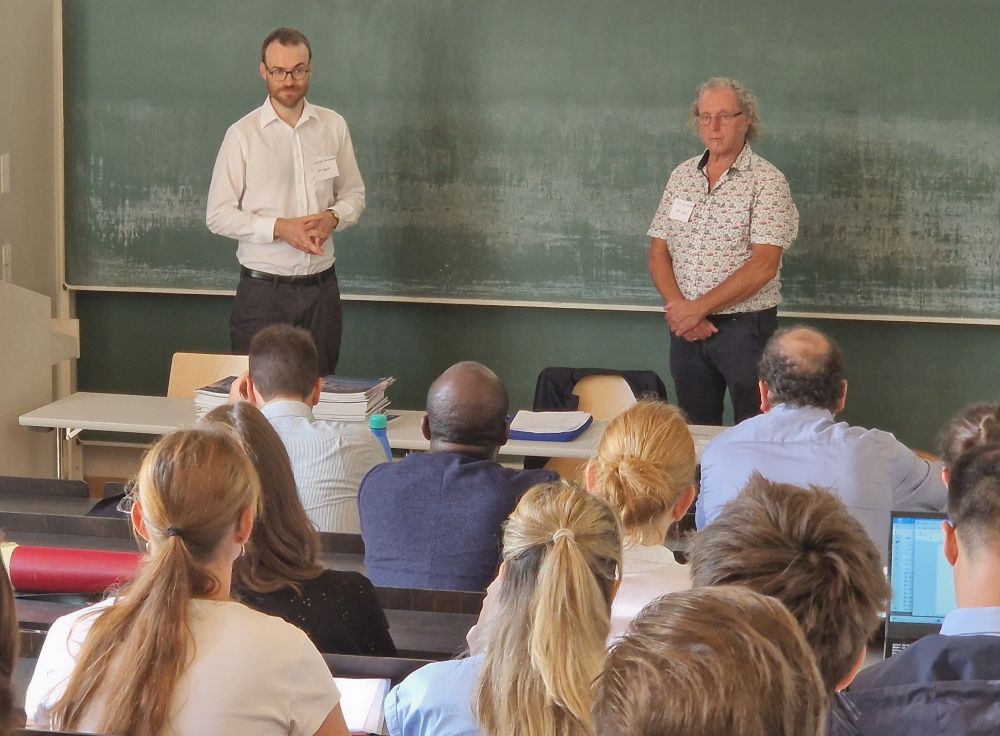
Photo: solrico
Where does thermal energy storage stand in today's market, and what research is needed to meet industry's requirements? These were the key questions addressed at a workshop held in mid-September in Freiburg, Germany, during the week of the Eurosun conference. The workshop, entitled Materials and Components for TES (PCM, TCM and High-Temperature Sensible Heat Storage), was co-organised by Christoph Rathgeber from the Bavarian Center for Applied Energy Research (ZAE) (left) and Wim van Helden from AEE INTEC, Austria (right). Two presentations at the workshop highlighted the dynamic development of the thermal energy storage industry and the wide range of applications for thermal storage technologies.
“We invited industry representatives to learn from them and align our future work with their needs,” explained van Helden, outlining the purpose of the event. He is the task manager of Task 74, Components for Thermal Energy Storage, within the Solar Technologies & Sustainable Heating and Cooling (STSHC) Programme.
With twelve industry representatives attending, the workshop attracted strong interest from the sector. Participating companies included high-temperature storage supplier Storasol and Nanolope, which offers phase change material (PCM)-filled panels for indoor climate control in residential buildings. Both companies are from Germany.
Also represented were Belgian company Destore, with its compact thermal energy storage solution for heat pump operation, and German engineering conpany SIK Peitz, which is developing a modular PCM storage system for industrial applications in collaboration with the German Aerospace Center (DLR). Rubitherm, another German company specialising in PCM-based storage solutions, also contributed actively to the discussions.
Industrial experts raised numerous questions during the workshop, covering topics such as materials selection, sensor requirements, boundary conditions for testing, models for numerical analysis, practical challenges in experimentation and implementation, and methods for cost analysis.
A handbook of commercial industrial thermal energy storage technologies
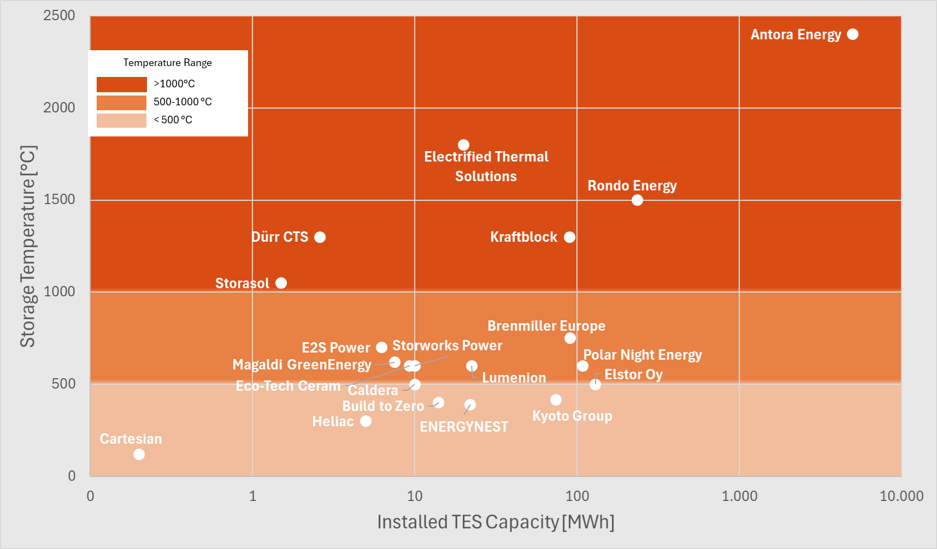
Figure 1: Thermal storage tank suppliers grouped by temperature range and installed thermal energy storage capacity in MWh.
Source: Thermal Energy Storage Handbook
The workshop discussions were structured around a series of presentations by experts in thermal storage technologies for different applications. Kevin Ludwig, for example, presented use cases in the fields of power-to-heat and heat-integrated Carnot batteries. Ludwig is researcher in the Department of Thermal Process Technology of the Institute of Engineering Thermodynamics of the German Aerospace Center (DLR).
The technology and application overview was developed as part of the IEA Energy Storage Programme and resulted in the publication of the Thermal Energy Storage Handbook. The handbook profiles 15 storage technology providers covering a broad temperature range from 100 to 2,400 °C. It also presents 14 implemented projects (plus 5 announced) at industrial customer sites, including their key technical data (see Figure 1).;
“With the handbook, we aim to provide a structured overview of commercially available medium- and high-temperature thermal energy storage technologies and key market actors,” explained Ludwig during the workshop.
The DLR researchers set out to establish a clear picture of what power-to-heat storage manufacturers have already achieved in terms of commercial projects. They are also currently preparing a policy brief to summarise key messages for policymakers and funding agencies, highlighting the opportunities and challenges in this rapidly developing industrial sector.
The Thermal Energy Storage Handbook is available for download here.

Figure 2: Two US-based providers of high-temperature solid-state thermal energy storage are featured in the Thermal Energy Storage Handbook. Antora Energy stores heat in carbon blocks at temperatures of up to 2,400 °C (left), while Electrified Thermal Solutions uses electrically conductive firebricks capable of reaching temperatures of up to 1,800 °C (right).
Photos: Antora Energy / Electrified Thermal Solutions
Mapping the thermal energy storage industry
Under Task 74 of the STSHC Programme, researchers are currently compiling a market overview of thermal energy storage technologies for different applications. The database now includes 94 providers. Wim van Helden presented the mapping results at the workshop in mid-September. A more detailed account of the findings has also been published in a blog post by Jorge Salgado Beceiro from the Norwegian research institute SINTEF Energy Research (see here). The mapping is based on publicly available data on storage tank suppliers, compiled by experts from Task 74. Beceiro emphasised that “thermal energy storages are not a single market. It is fragmented into several application-driven markets, each with different technical requirements, operating temperatures, storage durations and levels of commercial maturity.”
Figure 3 illustrates how latent thermal energy storage technologies, particularly those based on phase change materials (PCM), dominate applications in the domestic and building sectors. Their compact design makes them relatively easy to integrate into existing buildings. Sensible heat storage systems, by contrast, generally require larger storage volumes but can offer simpler designs and greater scalability for large installations and industrial processes.
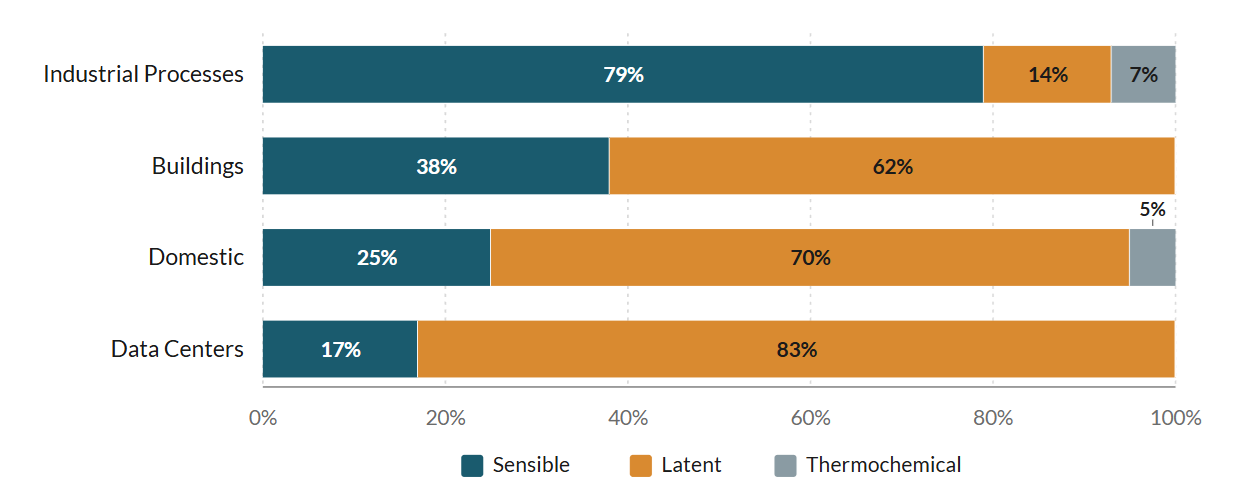
Figure 3: Distribution of thermal energy storage technologies by application, based on a mapping of around 70 commercial thermal energy storage suppliers worldwide. Data centres already feature as a distinct application category, although they still account for a relatively small share of the identified suppliers. Domestic stands for single-family buildings and apartments, whereas building stands for multifamily-buildings.
Source: SINTEF’s blog (link)
Figure 4 provides another perspective on the mapping results, showing how the commercial TES market is segmented by temperature range, with different technologies dominating different thermal regimes.
In the lower temperature ranges (below 25 °C and 25–100 °C), latent heat storage technologies, particularly PCM systems, are predominant. The picture changes considerably at higher temperatures (100–450 °C and above 500 °C), where sensible heat storage technologies dominate. These systems use materials such as concrete, recycled minerals and ceramic bricks to store heat.
By comparison, large-scale latent heat storage systems for industrial heat applications are still relatively rare. Thermochemical energy storage remains an emerging market segment. Although it offers promising theoretical advantages in terms of energy density and storage duration, commercially established solutions are still comparatively scarce.
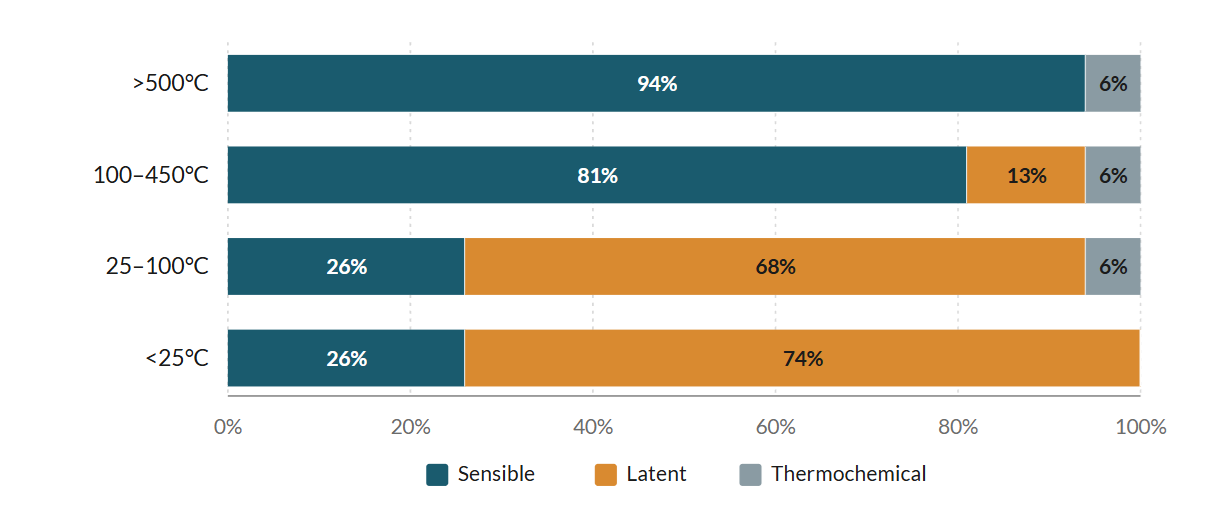
Figure 4: Distribution of thermal energy storage technologies by temperature range. Sensible heat storage involves raising the temperature of a solid or liquid storage material, while latent heat storage exploits the phase change of a material. Thermochemical storage relies on reversible chemical reactions.
Source: SINTEF’s blog (link)
More Information:
Thermal Energy Storage Handbook: https://www.dlr.de/en/tt/media/publications/other-publications-1/handbook
Blog about thermal energy storage overview: https://blog.sintef.com/energy/thermal-energy-storage-is-already-commercial
Websites of organisations mentioned in this news article:
Bavarian Center for Applied Energy Research (ZAE): https://zae-bayern.de
AEE INTEC: https://www.aee-intec.at/en
German Aerospace Center: https://www.dlr.de/de/tt
Storasol: https://storasol.com/en
Nanolope: https://nanolope.de
Destore: https://www.destore.energy/en#
SIK Peitz: https://www.sik-service.com/en
Rubitherm: https://www.rubitherm.eu/en
Antora Energy: https://www.antora.com
Electrified Thermal Solutions: https://electrifiedthermal.com
SINTEF Energy Research: https://www.sintef.no/en
IEA Energy Storage TCP: www.iea-es.org